AI agents in marketing: what they are, 2025 adoption data and how to implement them without failing
62% of companies already experiment with AI agents, but Gartner expects over 40% of those projects to be canceled. What they are, which tasks they automate and what separates the ones that work.

By Rubén García · October 10, 2026 · 3 min

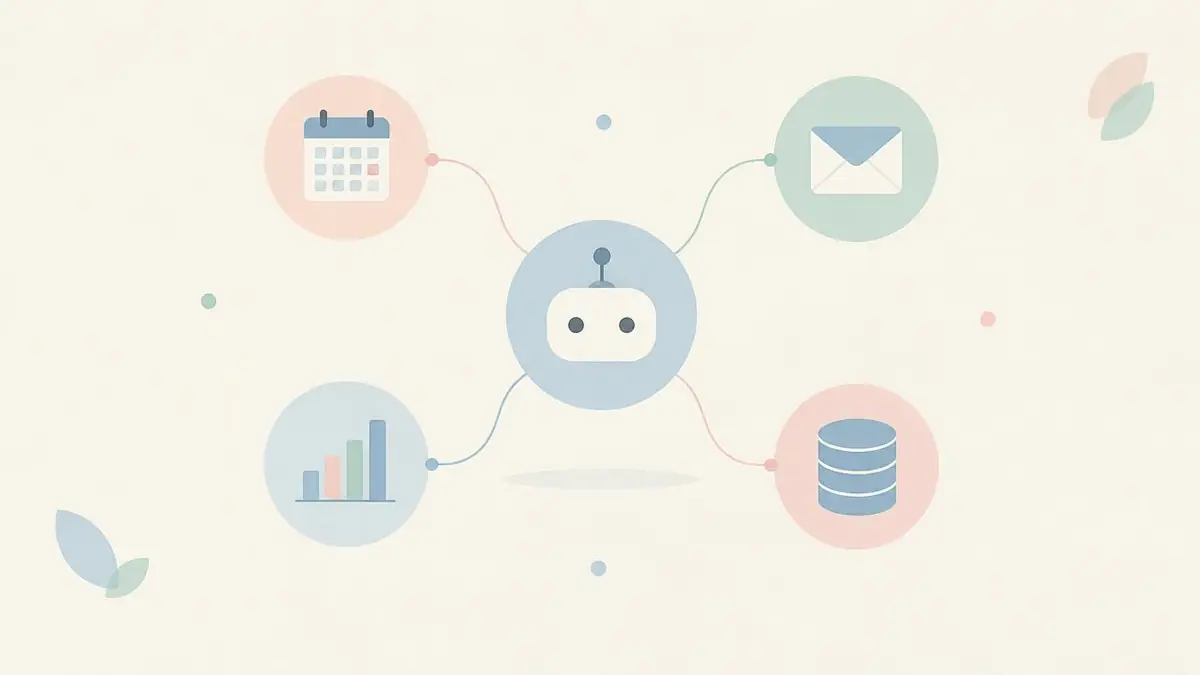
An AI agent is a system that doesn't just answer: it takes a goal, decides the steps and executes actions in your tools (CRM, ad platforms, email) with little supervision. In marketing, that means moving from asking a chatbot for copy to delegating whole tasks, like preparing a weekly report or scoring inbound leads.
How an agent differs from a chatbot or an automation
- Chatbot: answers a specific request. You decide the next step.
- Classic automation (Zapier, Make): always runs the same fixed sequence of rules.
- Agent: decides the sequence based on the goal and context, uses tools and corrects itself when something fails.
What the adoption data says
According to McKinsey (November 2025), 62% of organizations are at least experimenting with AI agents. Salesforce measured that agent creation among first-mover companies grew 119% in H1 2025, and 94% of consumers chose to talk to an agent when given the option.
62%
organizations experimenting with agents (McKinsey, 2025)
+119%
growth in agent creation, H1 2025 (Salesforce)
33%
enterprise software with agentic AI by 2028 (Gartner)
>40%
agentic projects canceled by end of 2027 (Gartner)
Gartner also expects at least 15% of day-to-day work decisions to be made autonomously through agentic AI by 2028.
Your take, in one click
Does your team already use AI agents?
The warning few people mention
Gartner also predicts over 40% of agentic AI projects will be canceled by the end of 2027 due to escalating costs, unclear business value or inadequate risk controls. It estimates only about 130 of the thousands of vendors selling "agents" offer real agentic capabilities; the rest rebrand existing chatbots or automations, a practice the firm calls "agent washing".
Which marketing processes get automated first
The most common use cases are repetitive processes with available data and a measurable outcome:
- Lead scoring and routing based on fit and behavior.
- Generating ad and email variants for testing.
- Weekly performance reports with a summary and detected anomalies.
- Account research and personalized sales messaging, as covered in our Clay prospecting guide.
- Proposing and analyzing experiments, covered in experimentation with agents.
How to implement an agent without failing
- Pick a task with a clear metric (time saved, qualified leads, cost per result).
- Document the current process step by step before delegating it.
- Start with human review of every output and reduce review as errors drop.
- Limit permissions: the agent should only access the tools it needs.
- Compare monthly usage cost against the savings obtained.
The cited studies agree that surviving projects have a metric defined from the start and human review of the output. The edge isn't having agents, it's knowing which tasks to delegate and which still need human judgment.
Frequently asked questions
What is an AI agent in marketing?
An AI system that takes a marketing goal and executes the necessary steps itself in company tools such as the CRM or ad platform, with limited supervision.
How many companies use AI agents?
According to McKinsey (2025), 62% of organizations are at least experimenting with AI agents, though far fewer have scaled them in production.
Why do AI agent projects fail?
Gartner points to three causes: escalating costs, unclear business value and inadequate risk controls. It expects over 40% to be canceled by the end of 2027.
| Indicator | Figure | Source |
|---|---|---|
| Companies experimenting with agents | 62% | McKinsey, 2025 |
| Agent creation growth (H1 2025) | +119% | Salesforce |
| Consumers choosing to talk to an agent | 94% | Salesforce |
| Enterprise software with agentic AI by 2028 | 33% | Gartner |
+3 more data points. Subscribe free to see them.
Interested in AI agents in marketing? Every Thursday at 19:00 (London time), I send you a selection of AI marketing analysis and strategies, including topics like this. Free.
Source: McKinsey · Salesforce · Gartner